education
How to Read an Essential Oil Label (Without Falling for Marketing)
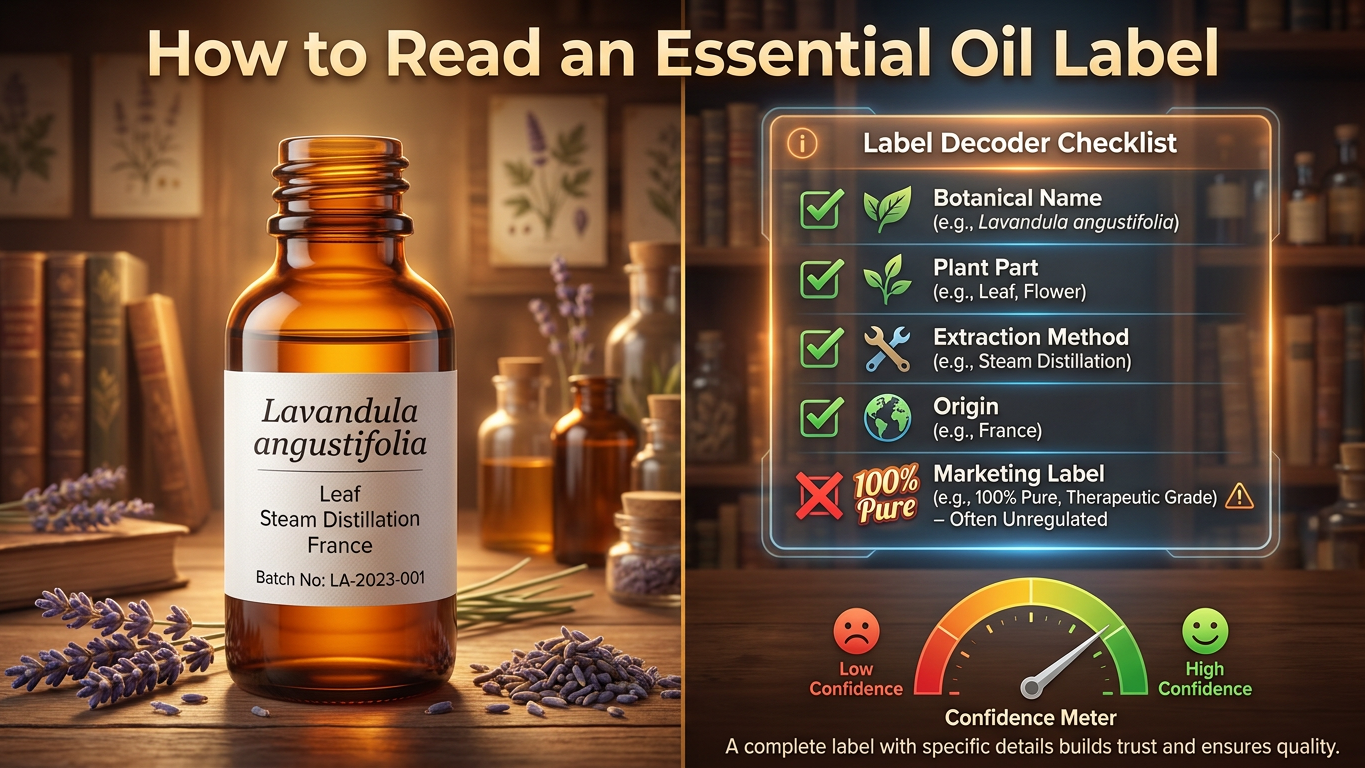
Here's a secret most oil shops don't want you to know: terms like 'therapeutic grade' and 'pharmaceutical grade' are completely unregulated marketing language. There's no governing body that defines them, and any company can use them.
So what should you look for instead? Here's our cheat sheet.
1. Latin botanical name
A real oil bottle will list the Latin name of the plant — for example, Lavandula angustifolia for true lavender, not just 'lavender.' Different species have different chemistry, and serious oil makers always tell you exactly which one you're buying.
2. Country of origin
Where was it grown? Authentic suppliers are proud of their sourcing. If a label is silent on origin, that's a yellow flag.
3. Extraction method
Steam distillation and cold pressing are the gold standard. Solvent-extracted oils are a different product (often called 'absolutes') and shouldn't be used the same way.
4. Batch number
Real oils get tested per-batch. A batch number on the bottle means there's a real lab report somewhere with that batch's name on it.
5. Amber or cobalt glass
Clear glass and plastic are red flags. Both let UV light degrade the oil. Real oils come in dark glass for a reason.
Three things you don't need to care about
First, the word 'organic' alone — it's nice but doesn't tell you anything about purity or potency. Second, fancy words like 'therapeutic grade' or 'pharmaceutical grade' (we covered why above). Third, claims that an oil 'cures' anything — no honest oil maker will say this, because no oil should be used as a substitute for medical care.
When in doubt, ask. Any oil maker who can't answer simple questions about source and testing is probably not the one you want.